
Three Initial Questions on the Impact of Customs Law Reforms on the Use of Digital Seals via VUCEM Starting in 2026
In October 2025, a significant reform to the Mexican Customs Law (Ley Aduanera) and its complementary regulations was approved, with the objective of modernizing and expanding the way foreign trade operations are documented, supervised, and controlled in Mexico. These amendments include the implementation of technological tools in customs procedures, such as the use of electronic systems and digital certificates to authenticate documents transmitted through VUCEM.
This reform, which introduces new technological compliance obligations for importers, exporters, and customs brokers, entered into force on January 1, 2026.
QUESTION 1: What are the new technological obligations for importers, exporters, and customs brokers?
The reform establishes that foreign trade participants must implement integrated electronic systems capable of enabling:
Inventory control and digital traceability
Real-time monitoring of operations
Electronic transmission of information and documentation
Mandatory integration with official platforms such as VUCEM
As a result, the role of digital seals has expanded significantly, as they now serve as the official authentication mechanism for all electronic transmissions, not only for customs entries (pedimentos). This makes the digital signature an essential and binding component of customs operations.
QUESTION 2: What happens with Article 59 of the Customs Law?
Article 59 of the Mexican Customs Law establishes the core obligations that must be fulfilled by parties introducing or extracting goods from Mexican territory in foreign trade operations. While the reform did not directly amend Article 59, it did introduce substantial changes in how these obligations must be fulfilled.
Through the 2025 General Foreign Trade Rules (RGCE), the electronic transmission of the Electronic Manifestation of Value (MVE) via VUCEM became mandatory, using digital formats such as Form E2, which must be signed using the importer’s or exporter’s e.firma or digital seal.
Although the MVE was originally scheduled to become mandatory in December 2025, its enforceability was postponed to April 1, 2026, allowing for a more gradual transition from traditional practices (paper-based submissions, handwritten signatures, or reliance on the customs broker’s seal) to a fully digital model with direct responsibility borne by the importer or exporter.
QUESTION 3: If digital seals already existed, what makes 2026 different?
Before 2026…
Digital seals already existed (Digital Seal Certificates used for tax documents and certain customs filings), but they were not mandatory for all electronic procedures submitted through VUCEM.
In many cases, customs brokers transmitted or signed documents on behalf of importers or exporters, particularly for paper-based or manually filed Manifestations of Value.
Starting in 2026…
The transmission of the Electronic Manifestation of Value, certificates, and other electronic documents (E-Documents) must be executed using the importer’s or exporter’s own digital seal, rather than relying solely on the broker’s seal or the platform’s credentials.
This change means that the directly obligated party (importer or exporter) assumes full legal and tax responsibility for the accuracy of the information submitted, reinforcing data integrity and traceability within the Mexican customs system.
Furthermore, the Customs Law reform and the RGCE clearly point toward full digitalization, where the digital seal functions as a legal validation mechanism for each customs transaction.
The reforms to the Customs Law and the General Foreign Trade Rules promote a foreign trade framework that is more digital, competitive, and secure. At Integración Aduanal we know that the mandatory use of digital seals in VUCEM starting in 2026 represents not only a technological shift, but also a significant legal and operational transformation for importers, exporters, and customs brokers, as it:
Strengthens the legal accountability of the declaring party
Enhances data integrity and traceability
Drives the modernization of customs procedures
Reduces the risk of errors, undervaluation, and inconsistencies
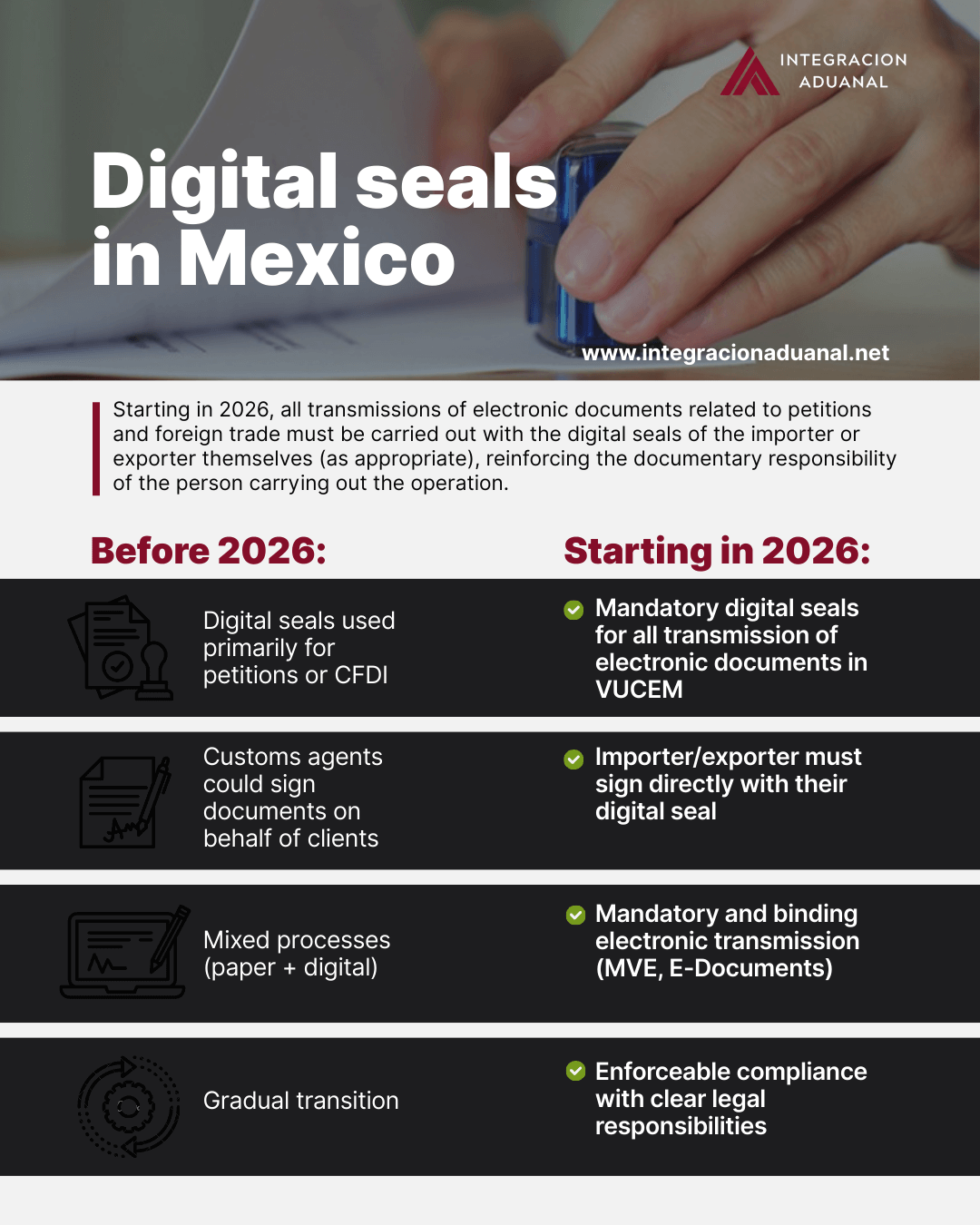
Infographic on the use of digital seals | Image created in Canva, by Integración Aduanal
Although the mandatory enforcement of the Electronic Manifestation of Value was deferred until April 2026 to ease the transition, the legal framework supporting this change is already in place, requiring companies to prepare for operating within a fully digital customs environment.
References:
Albatrans International Freight Forwarders. (2026, January 9). MANDATORY USE OF VUCEM DIGITAL SEALS BY IMPORTERS/EXPORTERS STARTING IN 2026. https://www.linkedin.com/pulse/mandatory-use-vucem-digital-seals-importersexporters-lqyge
Gomsa. (2025, enero 09). USO OBLIGATORIO DE SELLOS DIGITALES VUCEM DEL IMPORTADOR/EXPORTADOR a PARTIR DE 2026 | GOMSA | Boletines – Agencias aduanales – Logística integral. https://publicaciones.gomsa.com/2026/01/uso-obligatorio-de-sellos-digitales-vucem-del-importador-exportador-a-partir-de-2026-2/
Ley Aduanera. (noviembre 19, 2025). Ley Aduanera, Título Tercero: Contribuciones, cuotas compensatorias y demás regulaciones y restricciones no arancelarias al comercio exterior | Capítulo I: Hechos gravados, contribuyentes y responsables, Artículo 59. Diario Oficial de la Federación [D.O.F.] Recuperado de https://www.diputados.gob.mx/LeyesBiblio/pdf/LAdua.pdf
VUCEM. (2025). Manifestación de Valor a través de la VUCEM. In www.ventanillaunica.gob.mx (Hoja informativa No. 08). Ciudad de México. https://www.ventanillaunica.gob.mx/vucem/meses/agosto2025/Hoja_informativa_No_08_Manifestacion_de_Valor.pdf