
Artificial Intelligence in Warehousing: How It Is Transforming Logistics
Artificial Intelligence (AI) may seem like a very new concept that is currently trending. You have probably already interacted with this technology in some way—perhaps to reduce the time required to complete a task, organize large volumes of information, solve a very specific question within a particular context, or obtain a highly detailed explanation on a specific topic.
However, Artificial Intelligence (even before it was called that) has its origins in the late 19th century, based on the premise that logical reasoning could be systematized and on the question of whether machines could imitate human intelligence. At that point in history, around the 1940s, the first general-purpose electronic computer had not yet been invented.
The Early Use of AI in Logistics
It was not until the 1980s that Artificial Intelligence began to be used in logistics through expert systems designed for specific planning and inventory management tasks.
Its exponential growth in warehouse automation emerged in the 2010s, driven by three major technological developments:
Big Data: Provides massive, fast, and diverse datasets that allow the identification of patterns, trends, and complex behaviors.
Robotics: Uses machine-learning algorithms to improve perception, decision-making, and operational autonomy.
Machine-learning algorithms: Serve as the core connection between Big Data and robotics.
In short, Big Data provides the information, algorithms process that information, and robots execute the resulting decisions autonomously.
How Artificial Intelligence Improves Warehousing
“Artificial Intelligence improves warehousing by increasing efficiency, accuracy, and responsiveness to demand.”
But how does it achieve this?
AI does more than simply increase productivity or reduce costs. It integrates Big Data, robotics, and machine-learning algorithms to create intelligent and highly efficient warehouse management systems.
This is how each component contributes:
Big Data
What It Does?
Collects information through IoT sensors, RFID tags, sales data, and operational records.
Why Does He Do It?
Provides a comprehensive, real-time view of all warehouse assets and processes, enabling faster and more proactive decision-making.
Machine-Learning Algorithms
What It Does?
Determine product placement based on inventory turnover.
Predict demand accurately (including seasonal trends and promotional campaigns) and compare it with available stock.
Dynamically adjust inventory levels.
Optimize picking routes to reduce time and travel distance.
Why Does He Do It?
Prevent both overstocking and stockouts while ensuring a consistent and efficient inventory flow.
Robotics
What It Does?
Monitor the condition of machinery and equipment.
Perform predictive maintenance to anticipate equipment failures before they occur.
Scan shelves continuously.
Conduct automated inventory counts.
Transport products throughout the warehouse.
Why Does He Do It?
Reduce downtime and repair costs, accelerate operations, improve order-picking accuracy, and minimize errors.
Key Benefits of AI in Warehousing
By implementing AI in warehouse operations, companies can achieve:
Operational optimization
Intelligent inventory management
Predictive maintenance
Greater visibility and better decision-making
But beyond these benefits, understanding the specific functions of AI helps explain how warehouses can adapt quickly to demand spikes and changing market conditions.
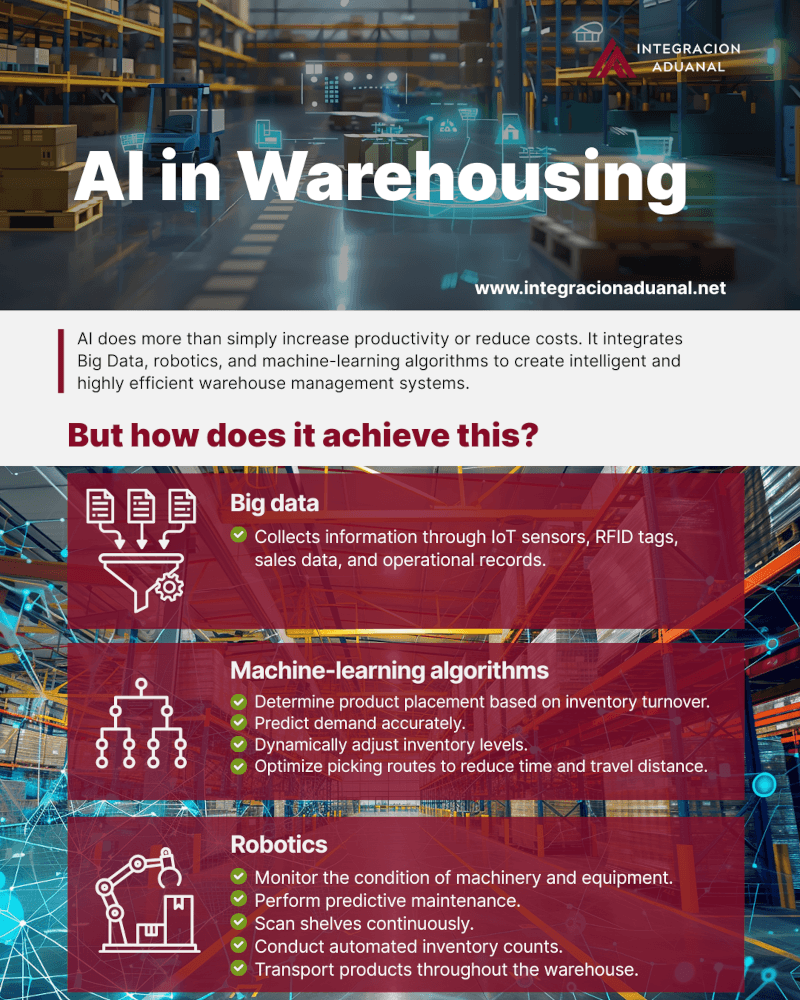
Infographic on the use of AI in warehouse management | Image created in Canva, by Integración Aduanal
Artificial Intelligence reminds us that logistics is not only about the physical movement of goods. It is also a decision-making system based on logic, planning, and continuous optimization, enabling warehouses to become faster, safer, more sustainable, and more profitable.
Reference:
Corp, B. (2025, abril 23). Brain Corp: 10 ventajas de los robots y la IA en la gestión de inventarios que quizá no haya considerado. https://www.braincorp.com/es/resources/10-benefits-of-robots-ai-in-inventory-management-you-may-not-have-considered
Florit, J. (2024, octubre 19). Datificación a través de IA, robótica y aprendizaje automático. Thinking for Innovation. https://www.iebschool.com/hub/datificacion/
GT+Logistics. (2026, January 27). Big Data e Inteligencia Artificial en la logística: usos. https://blog.gtlogistics.com/big-data-e-inteligencia-artificial-en-la-logistica-usos
Hernández, V. (2026, febrero 20). Inteligencia Artificial, una realidad que ya marca la diferencia en la logística. Revista TyT. https://www.tyt.com.mx/nota/inteligencia-artificial-una-realidad-que-ya-marca-la-diferencia-en-la-logistica
National Geographic España. (2025, enero 16). Breve historia visual de la inteligencia artificial. nationalgegraphic.com
https://www.nationalgeographic.com.es/ciencia/breve-historia-visual-inteligencia-artificial_14419
Sala, I. (2024, mayo 25). ¿Sabías que el primer ordenador se creó en 1946? Esta es su historia. HardZone. https://hardzone.es/noticias/equipos/historia-primer-ordenador/
Star, R. S. (2026, febrero 27). La Evolución de la Inteligencia Artificial a lo largo del tiempo. Serenity Star. https://serenitystar.ai/es/blog/la-evolucion-de-la-inteligencia-artificial-a-lo-largo-del-tiempo