
Physical AI and Thinking Warehouses
The path toward Physical AI began with basic warehouse automation, warehouse management systems (WMS), and mobile robots for picking operations. However, the real breakthrough occurred when advanced sensors, Big Data, and machine learning algorithms were integrated. Today, this evolution allows robots not only to execute tasks, but also to interpret what is happening within the logistics environment and react in real time.
What is Physical AI?
Physical AI is the combination of artificial intelligence with real-world machines such as robots, sensors, autonomous vehicles, and industrial equipment.
Unlike traditional automation, which simply repeats tasks, Physical AI enables machines to:
Perceive their environment
Make decisions in real time
Adapt to dynamic changes
In other words, machines no longer just execute tasks, they now “think” while operating.
According to the World Economic Forum, Physical AI allows logistics systems to evolve from rigid processes into intelligent systems capable of continuously learning and adapting.
What does a warehouse that implements Physical AI look like?
One of the most important concepts introduced by Physical AI is that of “thinking warehouses.”
This means that:
The warehouse operates as a single intelligence
There is a “central brain” coordinating robots, data, and people
Every process is optimized in real time
Instead of being just an operational space, the warehouse becomes a strategic asset that generates insights and value.
Within distribution centers, Physical AI enables functions such as:
Environmental perception
Systems can “see” the warehouse as it truly is: dynamic, constantly changing, and imperfect, through computer vision and sensors.
Autonomous decision-making
Robots determine routes, picking priorities, and movements without fully relying on human instructions.
Intelligent coordination
All components (robots, systems, and humans) work as a single integrated system, optimizing every movement.
Continuous learning
Systems improve over time by learning from historical data and real operational behavior.
Who is implementing Physical AI?
Physical AI is already being implemented in real logistics operations:
Companies like Macy’s have developed highly automated warehouses where robots can prepare orders in less than a day, improving delivery times and operational efficiency.
Major technology and logistics companies are investing billions in autonomous and even humanoid robots to operate warehouses and address labor shortages.
In the United States, companies like Walmart are modernizing their distribution centers with advanced robotics to increase capacity without expanding infrastructure.
In Mexico, although adoption is still growing, technological advancement and logistics digitalization indicate that this model will become increasingly common in modern distribution centers.
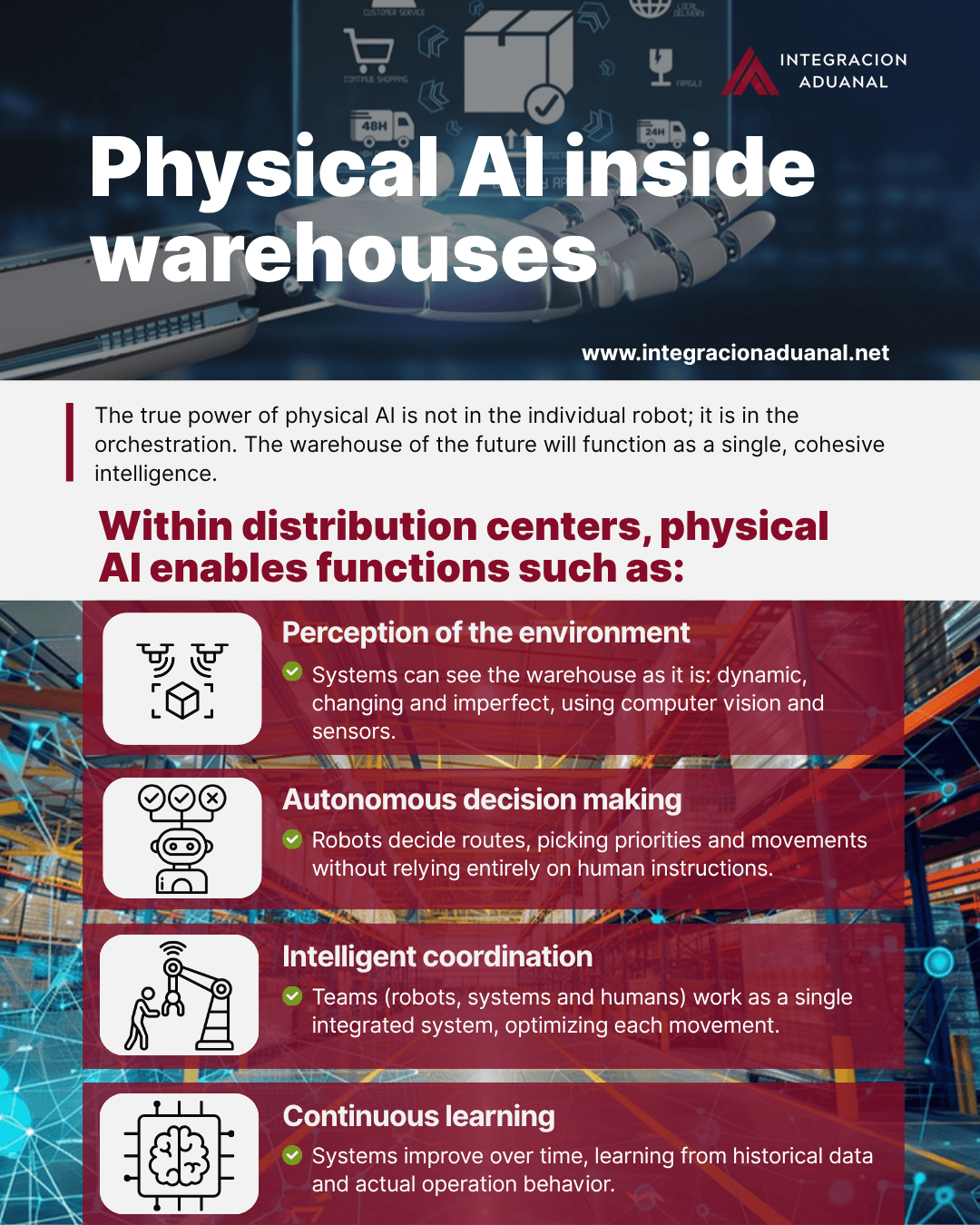
Infographic about physical AI within the warehouse | Image made with canva, by Integración Aduanal
In conclusion, this is not just about automating processes—it is about creating systems that learn, adapt, and are capable of responding in real time to an increasingly complex environment.
References:
Iszler, M. (2024, December 30). Walmart to invest $19.5M in tech upgrades at its New Braunfels distribution center. San Antonio Express News. https://www.wsj.com/articles/macys-employs-warehouse-robots-to-speed-up-deliveries-81385a14?utm_
Kuffner, J. (2026, January 18). Physical AI in the supply chain: How its promise can be realized. World Economic Forum. https://www.weforum.org/stories/2026/01/physical-ai-in-the-supply-chain-how-its-promise-can-be-realized/
Valverde, D. (2026, January 12). Technology Became the New Global Economic Infrastructure. Mexico Business News.
https://mexicobusiness.news/tech/news/technology-became-new-global-economic-infrastructure
Young, L. (2025, October 23). Macy’s Employs Warehouse Robots to Speed Up Deliveries. The Wall Street Journal. https://www.wsj.com/articles/macys-employs-warehouse-robots-to-speed-up-deliveries-81385a14?utm_